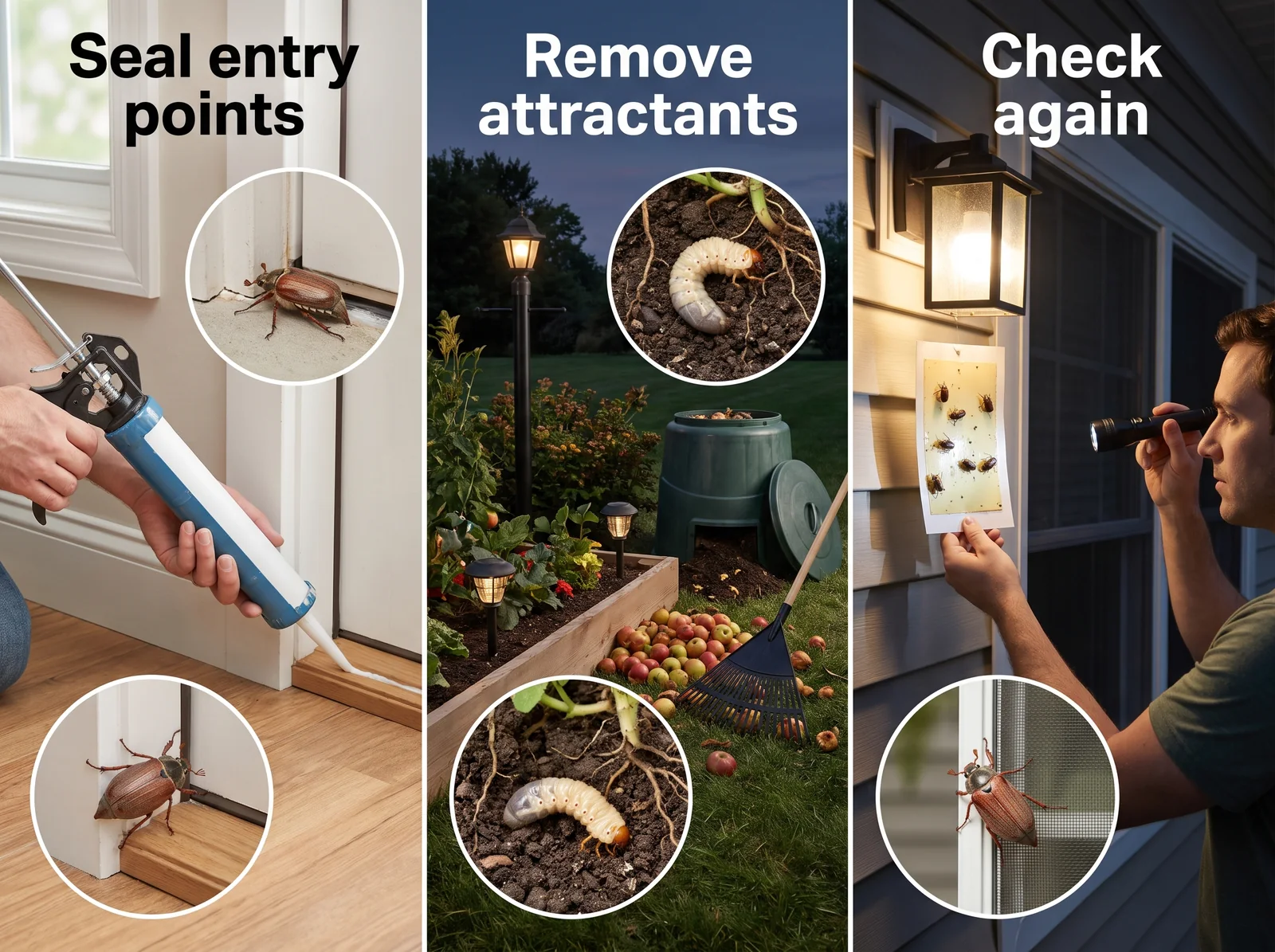
Why are june beetles attracted to your property?
June beetles emerge from the soil in late spring and early summer with two main goals: mating and finding food. Adult beetles feed on the foliage of broadleaf trees, shrubs, and garden crops, while females look for moist, healthy soil to lay their eggs. If your yard offers abundant host plants and exposed soil, beetles naturally congregate there.
Artificial nighttime lighting is the biggest trigger bringing adult beetles directly to your house. Bright porch lights, floodlights, and illuminated windows draw them in by the dozens. Once attracted, they bump into walls, drop onto decks, and search for nearby entry points or mating sites.
- Deciduous tree canopies such as oak, elm, and fruit trees
- Overwatered or poorly drained lawn areas
- Bright white, blue, or ultraviolet outdoor lighting fixtures
How does outdoor lighting affect beetle activity?
Bright white and bluish outdoor bulbs disrupt the navigational instincts of adult june beetles. When you run unshielded floodlights or standard porch lamps after dark, beetles fly directly toward the light source and exhaust themselves clinging to screens and walls.
You can significantly reduce beetle visits simply by altering your lighting habits. Turn off nonessential lights during peak flight periods, which usually last for three to four weeks in early summer. For necessary security fixtures, switch to warm yellow LED bulbs or sodium vapor lamps, which emit light wavelengths far less attractive to night-flying insects.
- Install motion sensors so lights only turn on when needed
- Swap cool-toned bulbs for yellow bug lights with low kelvin ratings
- Close indoor blinds and curtains at dusk to block ambient glow
How can you seal your home against them?
Because adult june beetles are clumsy fliers, they frequently crawl through small gaps around doorways, windows, and attic vents. Sealing your home's exterior creates a physical barrier that stops them from blundering indoors where they can create a nuisance.
Inspect all exterior screens for tears, bent frames, or loose edges. Check the weatherstripping along exterior doors and garage entries to ensure a snug seal against the threshold. If you have foundation vents or soffit openings, cover them with tight-fitting wire mesh to prevent adult beetles from wedging themselves inside.
- Patch holes in window and patio door screening immediately
- Apply silicone-based exterior caulk around window frame trim
- Ensure garage door bottom seals make firm contact with the slab
Can lawn care habits deter adult june beetles?
Your lawn care routine plays a major role in deterring egg-laying female beetles. June beetles prefer laying eggs in thin, low-cut grass where the soil surface is easily accessible. Maintaining a dense, taller turf canopy discourages females from landing and digging into the dirt.
Adjust your mower deck to keep your grass at least three to four inches tall during the active summer flight period. Deep, infrequent watering creates strong root systems that can resist grubs while avoiding the damp surface moisture that attracts egg-laying adults. Aerate compacted soil in autumn to support thick, resilient turf growth.
- Mow at the highest recommended setting for your specific turf species
- Water early in the morning so grass blades and soil dry by nightfall
- Overseed thin patches each season to eliminate bare ground
How do physical barriers protect your garden?
Valuable garden plants, young ornamental trees, and vegetable patches often suffer leaf damage when beetles feed at night. Setting up physical barriers provides reliable, chemical-free protection during the few weeks when adult feeding peaks.
Floating row covers made of lightweight mesh allow sunlight and moisture to reach your crops while keeping heavy adult beetles off the leaves. For small fruit trees or ornamental shrubs, you can drape fine netting over the canopy and secure it at the trunk. Handpick any stray beetles you spot at dusk and drop them into soapy water.
- Drape row covers over sensitive vegetables before sundown
- Use insect netting with mesh small enough to block large beetles
- Secure the bottom edges of garden fabric with landscape staples
What natural predators help reduce their numbers?
Encouraging natural predators in your landscape provides ongoing biological pressure on both adult beetles and underground grubs. Many common backyard animals rely on beetles as a vital seasonal food source.
Songbirds such as robins, starlings, and blue jays actively hunt adult beetles and dig up shallow grubs. Nocturnal wildlife including bats, toads, and harmless garden snakes also consume massive numbers of adult beetles each night. You can support these allies by installing birdbaths, keeping small brush piles, and hanging bat houses.
- Maintain bird feeders and fresh water sources across your yard
- Add native shrubs that offer shelter for insect-eating birds
- Avoid broad-spectrum surface sprays that harm beneficial wildlife
When should you consider pesticide treatments?
Pesticides are rarely necessary for adult june beetles because their flight period is brief and damage to mature trees is mostly aesthetic. However, if chronic grub populations consistently ruin your lawn, targeted treatments directed at young grubs in late summer may be warranted.
Always prioritize non-chemical prevention and lawn maintenance first. If you decide to apply a product, choose an EPA-registered product labeled specifically for lawn grubs and follow every instruction on the container. Apply the treatment only when grubs are actively feeding near the soil surface, and always water it in according to label instructions.
- Confirm grub presence by sampling a square foot of turf first
- Select an EPA-registered product labeled for your target lawn pest
- Apply treatments strictly during the recommended late-summer window
Questions you may still have
Do adult june beetles bite or sting humans and pets?
No, june beetles do not bite, sting, or carry diseases. Their mouthparts are designed strictly for chewing plant leaves. If one lands on your skin, its spiny legs might feel scratchy or cling tightly to fabric, but it cannot pierce human skin or harm your pets.
Are light traps effective for eliminating june beetles?
Light traps and bug zappers catch many insects, but they often attract more june beetles to your yard than they kill. They also destroy beneficial insects like pollinators and predator bugs. Changing your exterior bulbs to yellow bug lights is far more effective than trapping.
How long do adult june beetles stay active each year?
Adult june beetles usually remain active for only three to six weeks, typically between late May and July depending on your local climate. Once mating and egg laying finish, adult populations decline rapidly, leaving underground grubs as the remaining life stage.