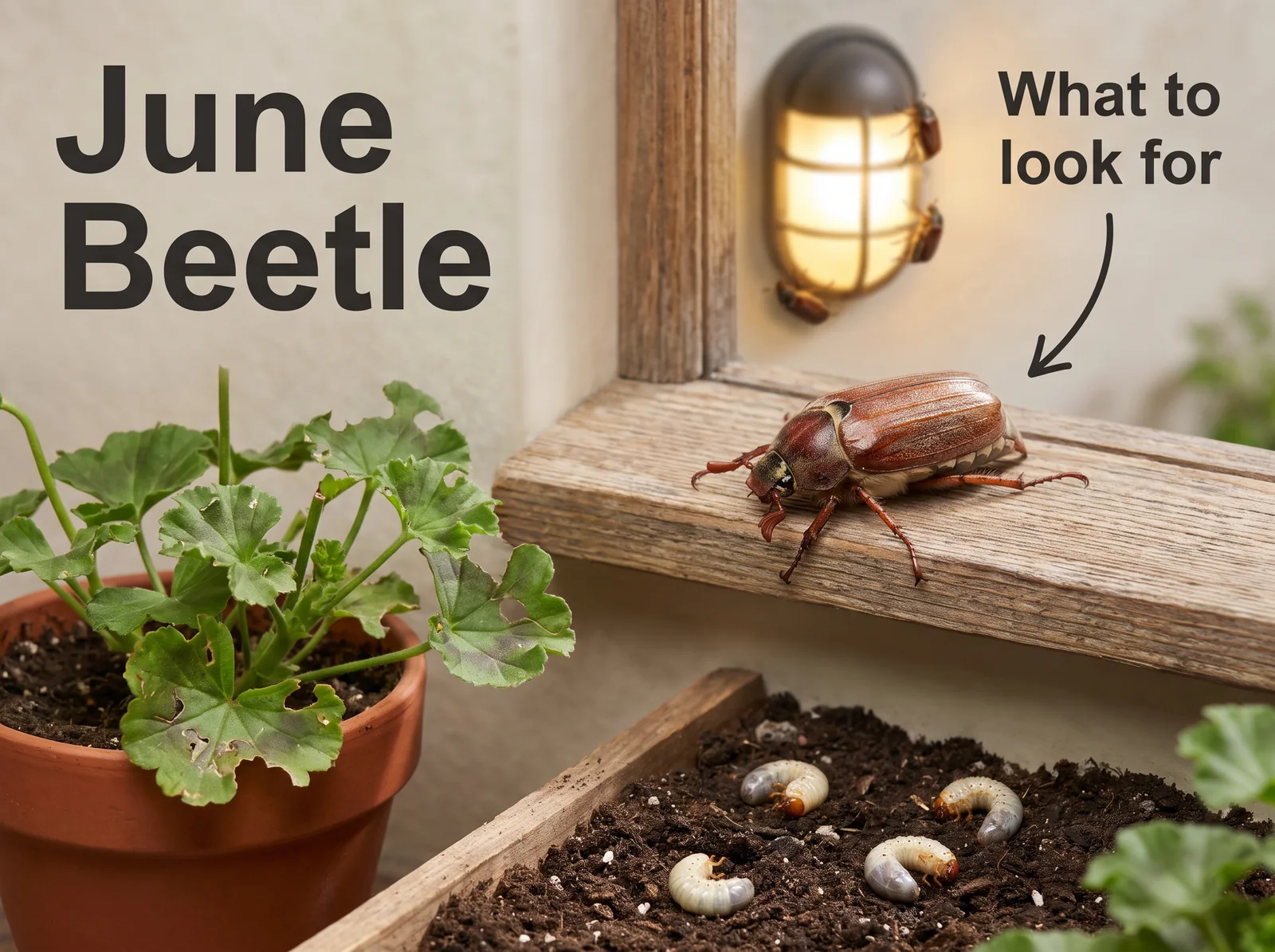
What do june beetle grubs look like?
June beetle grubs are plump, C-shaped larvae with off-white bodies, brown heads, and three distinct pairs of legs near the front. When fully grown, they measure about one-half to one inch long. Unlike some smaller soil pests, these grubs have a noticeable dark patch visible through the skin near their rear end, which is food moving through their digestive tract.
You will usually find them curled up in the top two to four inches of soil beneath dead or dying grass patches. As they feed on tender roots, the turf loses its anchor, making it easy to pull back sections of sod with your hands to spot the larvae underneath.
How can you tell if grubs are damaging your lawn?
Lawn damage often starts in midsummer as scattered, irregular brown patches that fail to green up after watering. Because the larvae sever grassroots beneath the soil line, the turf feels spongy underfoot. When damage becomes severe, you can roll the sod back just like a loose rug.
Secondary signs often involve wildlife. Raccoons, skunks, crows, and moles love feeding on fat grubs. If you wake up to find your turf dug up, scratched, or flipped over overnight, animals are likely hunting larvae hidden in the root zone.
How do you check your soil for an active infestation?
Before applying any treatments, you should measure how many grubs actually live in your yard. Cut a one-square-foot section of turf about three inches deep along the edge of a damaged area. Gently peel back the sod and sift through the dirt and roots with a trowel.
Count the number of C-shaped larvae you see in that square foot, then tamp the grass back down and water it. If you find fewer than five grubs, your lawn can usually recover on its own with proper care. A count of six to ten or more grubs per square foot indicates a heavy population that requires active intervention.
Can beneficial nematodes clear out grubs naturally?
Beneficial nematodes are microscopic, soil-dwelling roundworms that seek out and eliminate grubs from the inside out. Species like Heterorhabditis bacteriophora are particularly effective against beetle larvae. Because they are living organisms, they pose no risk to earthworms, pets, or beneficial garden insects.
Apply nematodes during late summer or early fall when young grubs are actively feeding near the surface. Water your lawn thoroughly before and after application to help the nematodes move smoothly through the soil layers. It is best to apply them during overcast days or late in the evening since direct sunlight and heat can kill them quickly.
Does milky spore work for long-term grub control?
Milky spore is a naturally occurring bacterium that targets certain beetle larvae in the soil. When a grub ingests the spores while feeding on roots, the bacteria multiply inside it, eventually killing the pest. As the grub decomposes, it releases billions of new spores into the surrounding dirt.
This biological approach builds up protection slowly over one to two years, but established spores can remain active in your soil for a decade or more. Apply the powder across your turf in a grid pattern and water gently to wash the spores into the root zone.
How does lawn care prevent future grub problems?
A thick, resilient turf canopy is your best natural defense against adult beetles looking for a place to lay eggs. Raise your lawnmower blade to maintain grass heights between three and four inches. Taller grass shades the soil, promotes deep root systems, and discourages female beetles from depositing eggs in your lawn during early summer.
Adjust your irrigation routine to favor deep, infrequent watering rather than light daily sprinkling. Moist surface soil during July invites egg laying, whereas allowing the top inch of dirt to dry out slightly between waterings can dehydrate fragile young larvae.
When are treatments most effective during the year?
Timing determines your success when targeting soil-dwelling larvae. Adult beetles lay eggs in June and July, which hatch into tiny, highly vulnerable grubs by August. Treating in late summer or early autumn catches them while they are small, hungry, and located near the surface.
Spring treatments are far less effective because surviving grubs are large, tough, and prepare to pupate. In late autumn, cooling temperatures push larvae deep into the subsoil below the reach of biological controls, so plan your primary control window between August and late September.
Questions you may still have
Do adult june beetles damage plants as much as grubs do?
Adult beetles feed on tree foliage, shrubs, and garden leaves at night, occasionally leaving ragged holes behind. However, their above-ground feeding is rarely fatal to healthy plants. The real structural damage occurs underground, where the larvae feed on turf roots for multiple seasons.
Will aerating my lawn help reduce grub numbers?
Core aeration mechanically crushes a small percentage of grubs, but its main benefit is improving soil health. Aeration breaks up heavy thatch, improves drainage, and allows biological controls like nematodes and water to reach the root zone where grubs live.
Can I use chemical controls if biological methods fail?
If an extreme infestation threatens your lawn, you can apply an EPA-registered product labeled specifically for lawn grubs. Always match the treatment timing to the grub life cycle and follow all manufacturer label instructions for proper soil moisture and application.