What are the signs of a June beetle infestation?
Adult June beetles are clumsy fliers that bump against windows, gather around bright outdoor fixtures, and nibble on ornamental foliage during warm evenings. While their feeding rarely kills mature trees or shrubs, their sudden abundance signals that eggs are being deposited directly into your turf.
Underground grub damage usually appears in late summer and early autumn. You might notice irregular patches of grass turning yellow and then brown, even with regular watering. In severe cases, the turf feels spongy underfoot and rolls back easily like loose carpet because the root system has been eaten away. Skunks, raccoons, and birds tearing up your lawn are another clear sign that grubs are feeding beneath the surface.
- Spongy, dying turf that lifts easily by hand
- Adult beetles gathering heavily around outdoor lighting
- Increased digging activity from nocturnal wildlife searching for food
How do you inspect your lawn for grub activity?
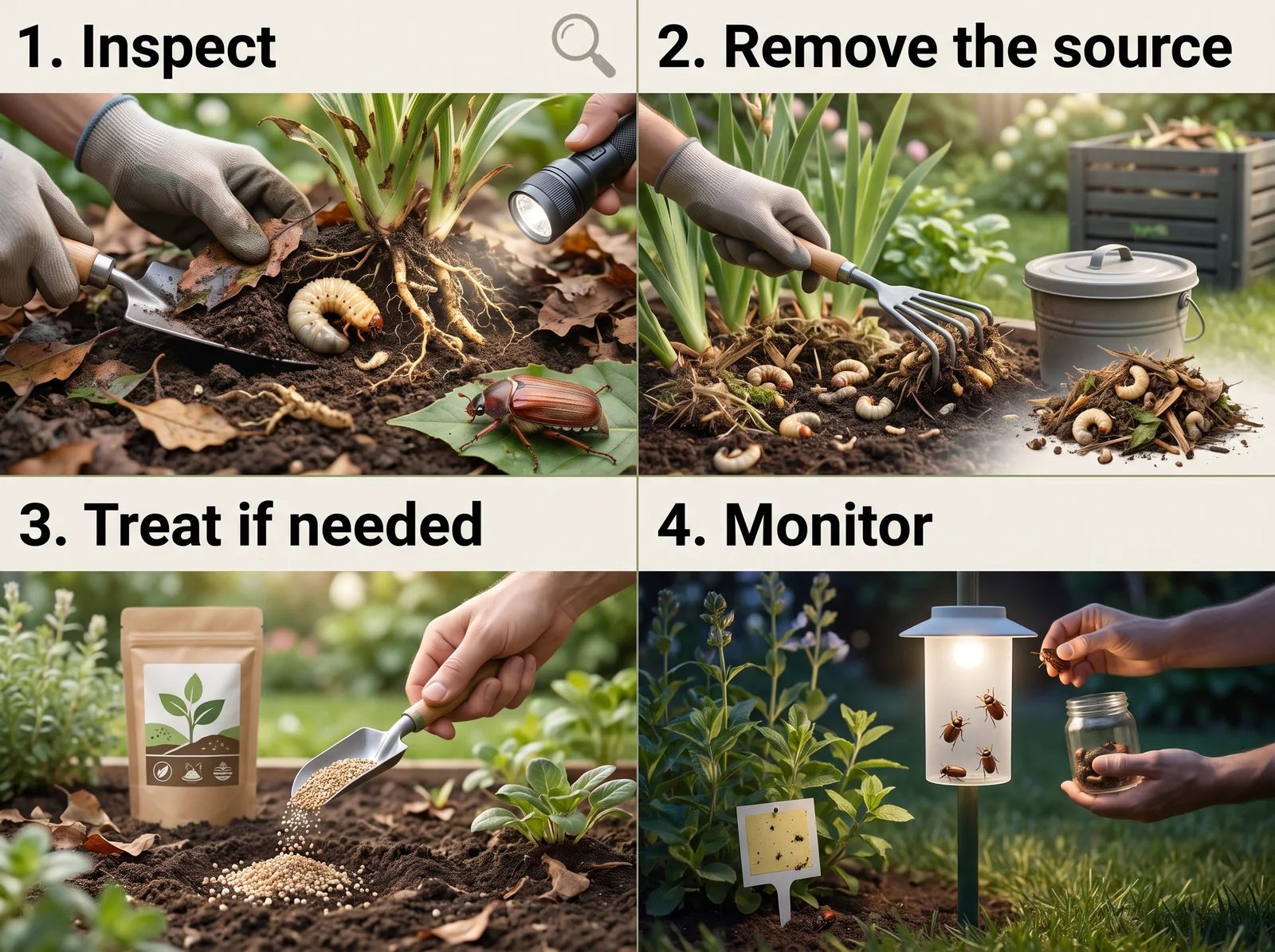
Before applying any treatments, you need to confirm that grubs are present and determine their density. Pick a few spots near the edges of damaged grass patches rather than testing the dead center, where grubs have likely already moved on to fresh roots.
Use a clean spade to cut a one-square-foot square of turf about three inches deep. Peel back the grass layer and gently sift through the top few inches of soil. Healthy lawns can easily tolerate a few grubs per square foot without showing stress. If you count more than five to ten C-shaped white grubs in that square foot, active treatment is recommended to prevent widespread turf loss.
How can you reduce adult June beetles around your home?
Adult beetles are strongly attracted to artificial illumination. One of the simplest ways to reduce their numbers around your house is to switch outdoor bulbs from cool white to warm yellow or sodium-vapor lights. These wavelengths are far less attractive to nocturnal insects, which helps keep beetles from gathering near your siding and laying eggs in adjacent flowerbeds.
For small garden areas, manual removal is surprisingly effective during peak flight weeks. Go outside at dusk with a flashlight and a bucket of soapy water. Shake affected branches over the bucket or pluck the beetles by hand and drop them in. Physical barriers like lightweight floating row covers can also protect vulnerable vegetables and fruit bushes until the short adult mating season ends.
Which cultural lawn practices help prevent beetle damage?
A dense, healthy root system is your best natural defense against root-feeding larvae. Adjust your mower to cut grass at a height of three to four inches. Taller grass shades the soil, promotes deeper rooting, and creates a dense canopy that makes it harder for female beetles to reach the soil and lay eggs.
Watering habits also play a major role in managing beetle populations. Female beetles prefer moist soil for egg laying in midsummer. Allowing your lawn to go naturally dormant or reducing irrigation during the peak July flight period makes the ground less hospitable. In contrast, deep and infrequent watering in spring and fall encourages strong root recovery without creating ideal egg-laying conditions.
What biological treatments work best for grubs?
Beneficial nematodes are microscopic roundworms that hunt down grubs in the soil without harming earthworms, pets, or beneficial garden insects. Strains such as *Heterorhabditis bacteriophora* are particularly effective against white grubs. For best results, apply them in late summer when grubs are small, actively feeding near the surface, and vulnerable.
Timing and moisture are critical when using biological controls. Apply nematodes on an overcast day or during the evening, as ultraviolet light and heat can quickly dry them out and kill them. Water the lawn thoroughly before and after application to help these microscopic organisms wash down through the thatch layer and reach the root zone where grubs reside.
When should you consider chemical treatments?
Chemical treatments should serve as a targeted option when biological methods and cultural care fail to keep grub counts below damaging thresholds. The most effective window for treatment is late summer, right after eggs hatch and young grubs begin feeding near the soil line. Mature grubs in early spring are much tougher to manage because they are larger and move deeper underground.
If you choose a pesticide, select an EPA-registered product explicitly labeled for white grubs or June beetles on residential turf. Always read and follow the entire product label regarding application timing, watering requirements, and safety precautions. Most soil treatments require immediate watering to move the active ingredients past the thatch layer and into the root zone.
How can you repair your lawn after treatment?
Once you have controlled the grub population, focus on restoring damaged turf before weeds take over bare patches. Rake away dead, loose grass to expose the soil underneath, and aerate compacted areas to improve oxygen and nutrient flow to struggling roots.
Overseed bare and thin spots in early autumn with a grass seed blend suited to your region and sun exposure. Lightly topdress the seed with compost, keep the area consistently moist until seedlings establish, and apply a balanced fertilizer to encourage rapid root growth. A well-maintained, thick lawn will better withstand any stray grubs in future seasons.
Questions you may still have
Can milky spore control June beetle grubs?
Milky spore is primarily formulated to control Japanese beetle grubs and has limited effectiveness against native June beetle larvae. If you are dealing specifically with June beetles, beneficial nematodes or targeted turf treatments labeled for general white grubs offer much more reliable control in your lawn.
Do adult June beetles bite or sting people?
No, adult June beetles cannot bite or sting. They possess small, gripping spines on their legs that can feel prickly or cling to your skin and clothing when they land on you, but they are completely harmless to humans and household pets.
Why do June beetle problems vary from year to year?
Many June beetle species have a life cycle that lasts two to three years underground before emerging as adults. Because different broods peak at different times and soil moisture heavily influences egg survival, you may see high adult populations in some years and very few in others.